Introduction
Safety Signs
Controls
Operating
Rotating Blades are Dangerous - Protect Children and Prevent Accidents
Avoid Damage to Plastic and Painted Surfaces
Replacement Parts
Service Safely
Service
Troubleshooting
Storing Machine
Assembly
Specifications
Warranty
John Deere Service Literature
John Deere Quality Statement
Copyright© Deere & Company

Operating
Operate Safely
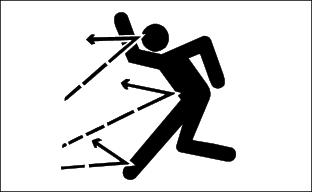
· Inspect machine before you operate. Be sure hardware is tight. Repair or replace damaged, badly worn, or missing parts. Be sure all shields and guards are in good condition and fastened in place. Make any necessary adjustments before you operate.
· Clear work area of objects that might be thrown. Keep people and pets out of the work area. Keep children in the house when you are operating the snowthrower. Stop machine if anyone enters the area.
· If you hit an object, stop the machine and inspect it. Make repairs before you operate. Keep machine properly maintained, clean, and in good working order.
· DO NOT throw snow toward people, cars, or buildings.
· DO NOT use snowthrower on surfaces above ground level, such as, a roof of a building.
· Be extremely careful if you must clear snow from a gravel path. Be aware that snowthrower may pick up gravel in snow. Adjust spout angle carefully to throw this snow safely.
· DO NOT leave machine unattended when it is running.
· Only operate during daylight or with good artificial light.
· Be sure of footing. Operate slowly on slippery surfaces. Be especially careful when you pull machine backwards with the engine running. Avoid holes, rocks, roots, etc.
· DO NOT throw snow across a slope. Be very careful when you change direction on a slope. Do not try to clear snow from a steep slope. Keep away from edge of a ditch or bank.
· Keep a firm hold on the machine handles. Avoid sudden starts and stops.
· DO NOT run engine in a building unless there is good ventilation.
Rotating Blades are Dangerous - Protect Children and Prevent Accidents
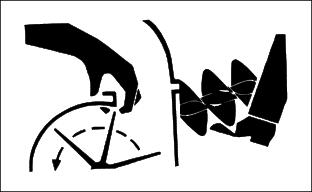
PROTECT CHILDREN:
· Never assume that children will remain where you last saw them. Stay alert to the presence of children.
· Keep children in the house when you are operating the machine.
· Turn machine off if a child enters the area.
· Use extra care when you come to blind corners, shrubs, trees, or other objects that may block your vision.
· DO NOT let children or an untrained person operate the machine.
HELP PREVENT SERIOUS OR FATAL ACCIDENTS:
· Be alert at all times, people especially children can move quickly into the area before you know it.
· DO NOT operate snowthrower if you are under the influence of drugs or alcohol.
· Keep hands, feet, and clothing away from discharge chute and auger.
Wear Appropriate Clothing
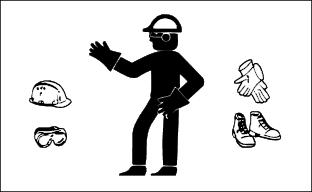
· Wear close fitting clothing and safety equipment appropriate for the job.
· Loud noise can cause impairment or loss of hearing, wear a suitable protective device such as earplugs.
· Do not wear radio or music headphones while operating the machine. Safe operation requires your full attention.
DAILY OPERATING CHECKLIST
Avoid Damage to Plastic and Painted Surfaces
· Be careful not to spill fuel on the snowthrower. The fuel may damage surface. Wipe up spilled fuel immediately.
Snowthrowing Tips
Clear snow immediately after it falls, if possible.
Overlap each swath slightly for complete snow removal.
Run engine at FAST speed for best snowthrower performance.
Throw snow down wind, if possible.
· Let the snowthrower go at its own pace.
· If snow does not flow freely, stop or back up to clear the snowthrower.
After you finish snowthrowing:
· Clean the snowthrower. Wipe it dry.
· Park and run the snowthrower a few minutes to help prevent moving parts from freezing.
· Do not leave the snowthrower unattended with the engine running.
· Do not cover the snowthrower if the engine is warm.
Adjusting the Chute
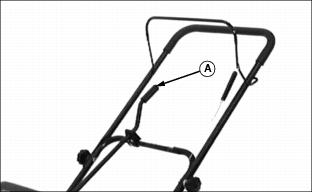
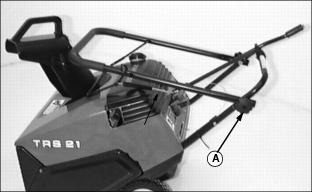
Turn the crank (A) to throw snow in the desired direction.
The chute will turn 90° to the left or right.
Adjusting the Spout
 c CAUTION: Avoid injury! DO NOT adjust the spout while the auger is ENGAGED.
|
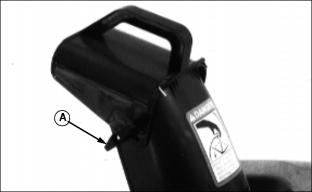
2. Move the spout to the desired position.
Manual Starting
|
c CAUTION: Avoid injury! Engine exhaust fumes can cause sickness or death.
|
IMPORTANT: Avoid damage! For operation above 2134 m (7000 ft), install the High Altitude Carburetor Kit. |
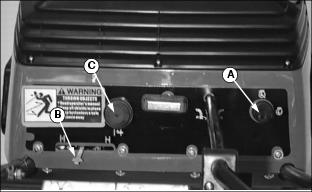
1. Turn the key to the ON position (A).
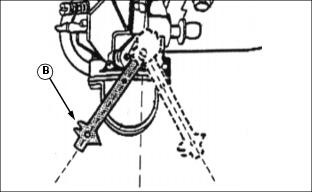
· Move the choke lever (B) to the CLOSED position.
· For temperatures ABOVE -12° C (15° F): Push the bulb (C) twice.
· For temperatures BELOW -12° C (15° F): Push the bulb (C) four times.
· Move the choke lever (B) to the OPEN position. DO NOT push the primer bulb.
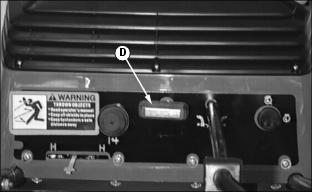
3. Pull the starter handle (D) fast and steady.
· If the engine does not start: Push the primer bulb twice and pull the handle until the engine starts.
· If the engine fires but does not run, do not choke it:
· Pull the handle until the engine starts.
· Repeat steps 2, 3 and 4 if necessary.
· Slowly move the choke lever to the OPEN position.
· Warm the engine briefly before you operate the snowthrower.
· The engine will run at FULL THROTTLE.
NOTE: To STOP the engine, turn the key to the OFF position.
Electric Starting
|
c CAUTION: Avoid injury! Engine exhaust fumes can cause sickness or death.
|
IMPORTANT: Avoid damage! For operation above 2134 m (7000 ft), install the High Altitude Carburetor Kit. |
NOTE: A snowthrower with electric start may also be started manually.
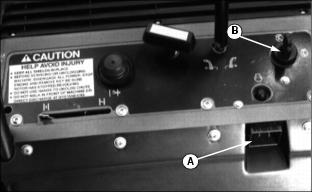
1. Plug the cord into the receptacle (A) FIRST, then into the house (120 volt AC) receptacle.
2. Turn the key to the ON position (B).
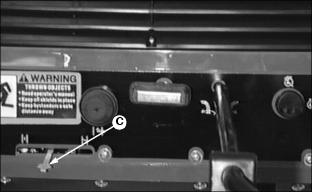
· Move the choke lever (C) to the CLOSED position.
· Move the choke lever to the OPEN position. Do not push the primer bulb.
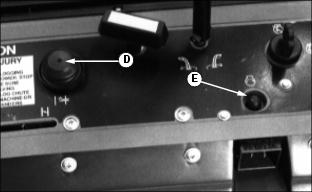
5. For temperatures ABOVE -12° C (15° F): Push the bulb (D) once.
6. For temperatures BELOW -12° C (15° F): Push the bulb twice.
7. Push the starter button (E) for 5 seconds. If the engine does not start, wait 10 seconds. Push the starter button for 5 seconds again. Repeat this procedure if necessary.
8. If the engine does not start: Push the primer bulb twice, then push the starter button again. If the engine fires but does not run, do not choke it. Repeat steps 2 through 5 if necessary.
· Slowly move the choke lever to the OPEN position.
· Warm the engine briefly before you operate the snowthrower.
· The engine will run at FULL THROTTLE.
10. Disconnect the cord from the house receptacle, then from the snowthrower receptacle.
NOTE: To STOP the engine, turn the key to the OFF position.
Using the Auger Bail
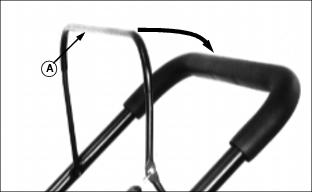
Pull and hold the bail (A) against the handle.