
47-Inch Front Mount for F900 Series and F1145
Introduction
Safety Signs
Preparing Vehicle
Installing
Removing
Operating
Stay Clear of Rotating Drivelines
Avoid Injury From Moving Parts
Avoid Injury From Hitting Obstructions
Raising and Lowering Snowblower
Transporting Front Mower and Snowblower Safely
Service Safely
Service
Troubleshooting
Storing Machine
Assembly
Specifications
John Deere Service Literature
John Deere Quality Statement
Copyright© Deere & Company

Operating
Operate Safely

· Check vehicle brake action before you operate. Adjust or service brakes as necessary.
· Inspect machine before you operate. Be sure hardware is tight. Repair or replace damaged, badly worn, or missing parts. Be sure guards and shields are in good condition and fastened in place. Make any necessary adjustments before you operate.
· Clear work area of objects that might be thrown. Keep people and pets out of the work area. Stop machine if anyone enters the area.
· DO NOT throw snow toward people, buildings or cars.
· If you hit an object, stop the machine and inspect it. Make repairs before you operate. Keep machine properly maintained and in good working order.
· Look carefully behind Front Mower before you back up, especially for children.
· DO NOT leave machine unattended when it is running.
· Only operate during daylight or with good artificial light.
· DO NOT let anyone, especially children, ride on machine or vehicle.
· DO NOT let children or an untrained person operate machine.
· DO NOT wear radio or music headphones while operating the machine. Safe operation requires your full attention.
· DO NOT operate machine if you are under the influence of drugs or alcohol.
Wear Appropriate Clothing
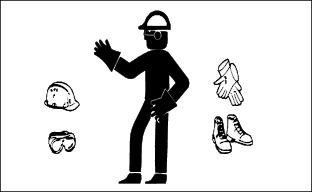
· Wear close fitting clothing and safety equipment appropriate for the job.
· Loud noise can cause impairment or loss of hearing, wear a suitable protective device such as earplugs.
Stay Clear of Rotating Drivelines
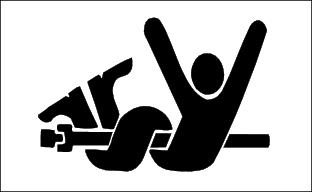
Entanglement in rotating driveline can cause serious injury or death:
· Wear close fitting clothing.
· STOP the engine and be sure PTO driveline is stopped before getting near it.
· Keep tractor master shield and driveline shields in place at all times. Make sure rotating shields turn freely.
Avoid Injury From Moving Parts
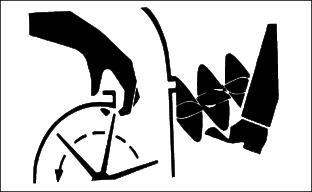
· Keep hands, feet and clothing away from snowthrower and discharge chute when auger is turning.
· Stop auger when you are not throwing snow.
· Stop vehicle engine before you unplug, repair, or adjust snowthrower.
Avoid Injury From Hitting Obstructions
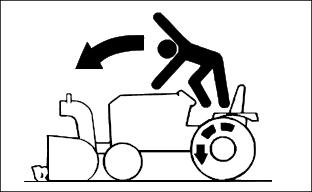
· Raise snowblower when you drive between jobs.
· Slow down when you remove snow.
Snowblowing Tips
Let engine and machine adjust to outdoor temperatures before starting to clear snow.
Thoroughly inspect the area snowblower to be used and remove all doormats, sleds, boards, wires, and other foreign objects.
Operate engine at full throttle.
Operate Front Mower at a safe travel speed.
Travel slowly when you are blowing wet, heavy snow to prevent plugging snowblower.
Slow down when you operate on slopes, before you make a turn, and when you operate close to buildings or trees.
For snowblowing in drifts, drift blade will cut through drifted snow and help break down drifts.
Use rear weights (See Install Weights and Chains in Preparing the Vehicle section.)
Wear adequate winter outer garments. Wear footwear that will improve footing on slippery surfaces.
For snowblowing on slopes, or other difficult conditions, install chains on front tractor tires.
Do not clear snow across the face of slopes. Exercise extreme caution when changing direction on slopes. Do not attempt to clear steep slopes.
Never operate snowblower without good visibility or light.
Blow snow downwind, if possible.
Put hydraulic control lever forward to float position when you are snowblowing on irregular ground.
Adjust runners for proper scraper blade clearance before you remove snow from irregular ground. (see Adjusting Height of Scraper Blade in this section)
Clean the snowblower after operation.
Adjusting Spout
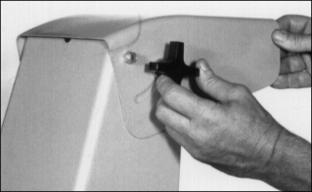
2. Move spout to desired position.
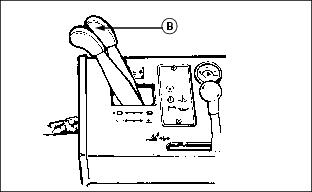
Raising and Lowering Snowblower
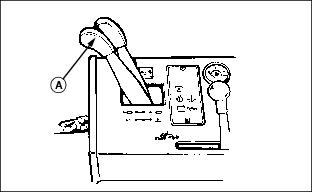
Pull hydraulic lever (A) to rear.
Push hydraulic lever (A) forward.
Push hydraulic lever (A) all the way forward. Float position allows snowblower to follow contours of ground.
Turning Chute
 c CAUTION: Avoid injury! DO NOT blow snow towards bystanders, buildings, or automobiles.
|
Starting Snowblower
|
c CAUTION: Avoid injury! Be sure area is clear before you begin snowblowing.
|
1. Disengage all clutches and shift into neutral before starting the engine.
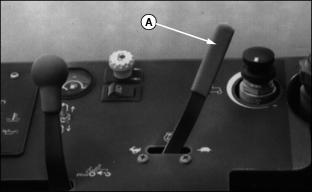
3. Move throttle lever (A) to one-fourth speed position.
4. Lower snowblower to ground.
IMPORTANT: Avoid damage! To prevent PTO clutch damage, DO NOT ENGAGE PTO with throttle in FAST position. |
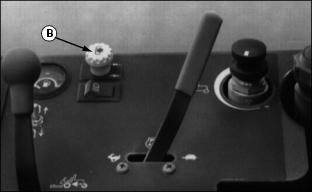
· On F1145: Pull up on PTO knob (B).
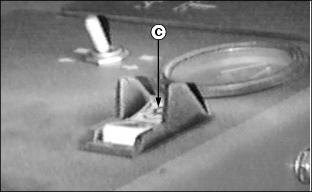
· On F900 Series: Push front of PTO switch (C) down.
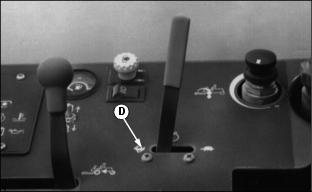
6. Move throttle lever to FAST position (D) for best engine and snowblower performance.
NOTE: If the unit should start to vibrate abnormally, stop the engine and check immediately for the cause. Vibration is generally a warning of trouble.
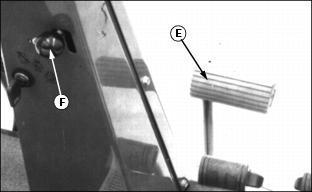
7. Push and hold service/park pedal (E) down.
8. Move knob (F) to the top of the slot and release pedal.
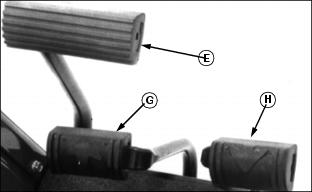
9. To travel FORWARD: Push pedal (G).
To travel in REVERSE: Push pedal (H).
For emergency STOP: Push pedal (E). PTO will also stop.
NOTE: Run machine a few minutes after blowing snow to prevent freeze-up of the collector/impeller.
Stopping Snowblower
NOTE: If engine and snowblower are running, engine and snowblower will stop when you get off operator's seat.
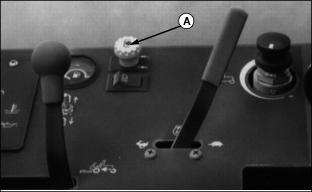
· On F1145: Push PTO knob (A) down.
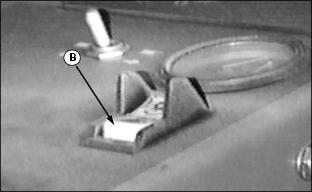
· On the F900 series: Push rear of PTO switch (B) down or depress service park brake to disengage PTO.
4. Lower snowblower to ground.
5. Lock park brake and remove key.
6. Wait for auger and blower to stop.
Using Differential Lock
|
c CAUTION: Avoid injury!
DO NOT operate at a high speed or turn when differential is LOCKED. |
The differential lock is used to provide better traction when rear wheels start to slip. Do not use differential lock unless you are experiencing rear wheel slippage. Engaging differential lock will cause both rear wheels to drive equally to improve traction.
IMPORTANT: Avoid damage! To help prevent damage to power train: · Do not LOCK differential when one wheel is spinning and the other wheel is stopped. |
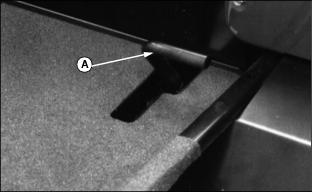
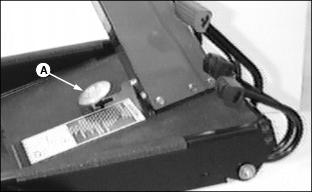
LOCK differential pedal (A) for better traction.
Front wheels stay LOCKED when you hold pedal down, or when traction is unequal.
Using Weight Transfer Valve
NOTE: Optional on the F911 and F1145. Standard on the F925 and F935.
1. Run engine at half throttle.
2. Push inner hydraulic lever forward to float position.
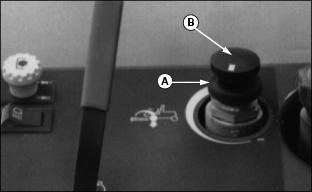
3. Turn lock knob (A) counterclockwise to unlock adjusting knob (B).
4. Turn knob (B) counterclockwise slowly until snowblower just begins to leave the ground. This will transfer approximately two-thirds of snowblower weight to Front Mower drive wheels.
5. Turn lock knob clockwise to lock adjusting knob.
6. Operate snowblower over uneven ground with hydraulic lever in float position. Snowblower should follow contours of ground.
7. Adjust weight transfer valve if snowblower does not follow contours of ground.
8. Also use this valve to adjust snowblower rate of drop when you lower snowblower.
Transporting Front Mower and Snowblower Safely
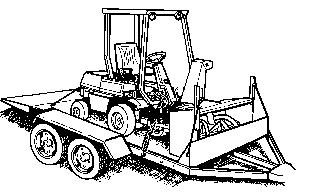
Disengage power to collector/impeller when the snowblower is transported or not in use.
Lower snowblower to trailer deck. Lock park brake.
(See your Front Mower operator's manual for more information.)