John Deere

OMM124509

Issue A9

F925 and F935 Front Mower

F925 Serial No. (150001 - )

F935 Serial No. (150001 - )

Introduction

Safety Signs

Controls

Operating

Lawn Care

Replacement Parts

Service Machine Safely

Service Intervals

Service Engine

Service Transmission

Service Steering & Brakes

Service Electrical

Service Miscellaneous

Checking Tire Pressure

Checking Tire Pressure (Continued)

Refueling Machine

Before Filling Fuel Tank

Filling Fuel Tank

Filling Fuel Tank (Continued)

Fuel Storage

Checking PTO Belt Tension

Lubricating the PTO Shaft

Opening Or Closing Hood

Cleaning Front Mower

Tighten Wheel Bolts And Other Hardware

Troubleshooting

Storing Vehicle

Assembly

Specifications

Warranty

John Deere Quality Statement

CopyrightŠ Deere & Company

All Manuals Close Window

Service Miscellaneous


Checking Tire Pressure
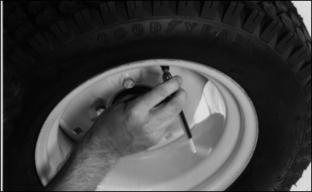
c CAUTION: Avoid injury! Explosive separation of a tire and rim parts can cause serious injury or death:

ˇ Do not attempt to mount a tire without the proper equipment and experience to perform the job.

ˇ Always maintain the correct tire pressure. Do not inflate the tires above the recommended pressure. Never weld or heat a wheel and tire assembly. The heat can cause an increase in air pressure resulting in a tire explosion. Welding can structurally weaken or deform the wheel.

ˇ When inflating tires, use a clip-on chuck and extension hose long enough to allow you to stand to one side and NOT in front of or over the tire assembly.

ˇ Check tires for low pressure, cuts, bubbles, damaged rims or missing lug bolts and nuts.


M33418

1. Check tires for damage.

2. Check tire pressure with an accurate gauge.

3. Add air, if necessary.

Checking Tire Pressure (Continued)

Tire Pressure Specificaitons

Front Tire Sizes 23 x 8.50 -12 And
23 x 10.50-12

Type Of Attachment

kPa (psi)

50-Inch Mower

110 (16)

60-Inch Mower

110 (16)

60-Inch Rear Discharge Mower

140 (20)

72-Inch Mower

140 (20)

76-Inch Rear

170 (24)

Collection System

150 (22)

46-Inch Snowthrower

150 (22)

47-Inch Snowthrower

150 (22)

54-Inch Blade

150 (22)

246 Rotary Broom

170 (24)


NOTE: ALL REAR TIRES = 16 x 6.50 - 8,
TIRE PRESSURE = 190 (28)

Attachment Caster Wheels

Type Of Attachment

Tire Size

kPa
(psi)

50 Inch Mower

9 x 3.5 - 4 Smooth Tire

180 (26)

60, 72, and 76 Inch Mowers

11 x 4.00 - 5 Smooth Tire

11 x 4.00 - 5 Ribbed Tire

275 (40) 150 (22)

47 Inch Snowblower

11 x 4.00 - 5 Smooth Tire

315 (46)


Refueling Machine

c CAUTION: Avoid injury! Handle fuel with care, it is highly flammable:

ˇ DO NOT refuel machine while you smoke, when machine is near an open flame or sparks, or when engine is running. STOP engine.

ˇ Fill fuel tank outdoors.

ˇ Prevent fires: clean oil, grease and dirt from machine. Clean up spilled fuel immediately.

ˇ Do not store machine with fuel in tank in a building where fumes may reach an open flame or spark.

ˇ To prevent fire and explosion caused by static electric discharge, while you fill tank, use a non-metal fuel container. If you use a funnel, MAKE SURE it is PLASTIC. Avoid using a funnel which has a metal screen or filter.

ˇ Use only clean oil and fuel and clean approved containers and funnels.

ˇ Store oil and fuel in an area protected from dust, moisture and other contamination.

Fuel

ˇ Use Grade No. 2-D fuel at temperatures above 4°C (40°F).

ˇ Use Grade No. 1-D fuel at temperatures below 4°C (40°F).

ˇ Use Grade No. 1-D fuel for all air temperatures at altitudes above 1500 m (5000 ft.).

ˇ For maximum filter life, sediment and water should not be more than 0.10 per cent.

ˇ The cetane number should be 45 minimum. If you operate your machine where air temperatures are normally low or in high altitudes, you may need fuel with a higher cetane number.

ˇ Cloud Point - For cold weather operation, cloud point should be 6°C (10°F) below lowest normal air temperature.

ˇ In winter use special winter fuel or add an anti-gelling compound to fuel to maintain its proper viscosity.

Diesel fuel storage:

IMPORTANT: Avoid damage! Diesel fuels stored for a long time may form gum and plug filters.

Diesel fuel stored in galvanized containers reacts with zinc coating on container to form zinc flakes. If fuel contains water, a zinc gel will form. Gel and flakes will quickly plug fuel filters and damage fuel injectors and pumps.


DO NOT use a galvanized container to store diesel fuel.

Store fuel in:

ˇ Plastic containers.

ˇ Aluminum containers.

ˇ Specially coated steel containers made for diesel fuel.

DO NOT use brass-coated containers, brass is an alloy of copper and zinc.

Before Filling Fuel Tank

IMPORTANT: Avoid damage! Avoid spilling fuel. Fuel can damage plastic and painted surfaces.

Fuel tank capacity:

F925: 20.8 L (5.5 gal)

F935 (2 Fuel Tanks): 41.6 L (11 gal)


ˇ Remove any trash from top of fuel tank drain area.

ˇ Never use fuel that is stale or has been stored for a long period of time:

Warm Weather: Maximum 60 days.

Cold Weather: Maximum of 90 days.

ˇ Fill fuel tank at the end of each day's operation. This helps to keep condensation out of fuel tank.

Filling Fuel Tank

1. STOP engine. If engine is hot let
it cool several minutes before you add fuel.
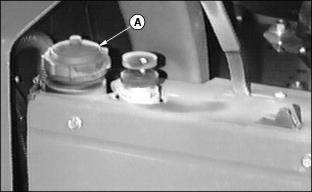

M78400

2. Remove fuel tank cap (A) slowly
to allow any pressure built up in tank to escape.

3. Fill tank only to bottom of filler neck.

4. Install fuel tank cap.

IMPORTANT: Avoid damage! To prevent damage to fuel injection system and to engine:

ˇ Use diesel fuel only.

ˇ Do not use home heating oil or gasoline.


Filling Fuel Tank (Continued)

Fuel Capacity:

F925: 20.8 L (5.5 U.S. gal)

F935 (2 Fuel Tanks): 41.6 L (11 U.S. gal)

Fill fuel tank(s) at end of each day's operation or when fuel gauge shows that you are near empty.

Fill fuel tank(s) only to bottom of filler neck.

Fuel Storage

NOTE: Diesel fuels stored for a long time may form gum and plug filters.

Keep fuel in a clean container in a protected area.

Water and sediment MUST BE removed before fuel gets to the engine.

Do not use deicers to remove water from fuel.

Do not depend on fuel filters to remove water.

If possible, install a water separator at storage tank outlet. (See your John Deere dealer for this part.)

IMPORTANT: Avoid damage! Keep all dirt, scale, water or other foreign material out of fuel.


Store fuel drum on its side with plug up.

Checking PTO Belt Tension

NOTE: The end of yellow gauge (A) MUST BE aligned with ends of springs (B) for proper belt tension.


M40157

1. Loosen nuts (C).

2. Tighten nuts (D) equally to get proper belt tension.

3. Tighten nuts (C) against nuts (D).

4. Adjust spring (E) to 21 mm (.84 in).

5. Check PTO belts for wear damage; replace if necessary.

Lubricating the PTO Shaft
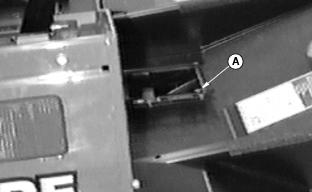

M78387b

1. Lubricate the rear universal joint on the PTO drive shaft by opening access door (A) and rotating PTO driveshaft until grease fitting is pointing upward.

2. Lubricate universal joint on front of PTO drive shaft from front of mower.

Opening Or Closing Hood
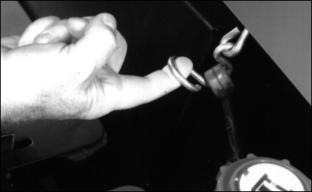

M38637

Disconnect rubber hold-down to open hood.

Connect rubber hold-down after closing hood.

Cleaning Front Mower

IMPORTANT: Avoid damage! To prevent damage to internal parts of the engine:

ˇ Follow the procedure below when washing your mower.


Before Washing:

ˇ STOP engine.

ˇ Let engine cool

Washing:

ˇ Never spray water directly against screens or engine openings such as exhaust pipe, air intake screens, or air cleaner.

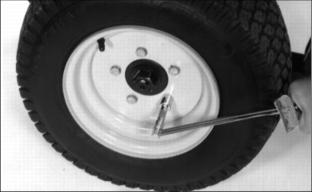
Tighten Wheel Bolts And Other Hardware

Look for loose hardware before each use and check wheel bolts often during operation.

M34370

Tighten Bolts:

ˇ Front Wheels: 95 Nˇm (70 lb-ft).

Drive Front Mower 30 m (100 ft). Change directions several times as you drive.

Tighten bolts again and after 3-10 hours use.
