
Sabre Yard and Garden Tractors
Introduction
Product Identification
Safety
Operating
Replacement Parts
Service Interval Chart
Service Lubrication
Service Engine
Engine Warranty Maintenance Statement
Cleaning Air Intake Screen and Engine Fins
Checking and Cleaning Air Cleaner Elements
Service Transmission
Service Mower
Service Electrical
Service Miscellaneous
Troubleshooting
Storing Machine
Assembly
Specifications
Warranty
Sabre by John Deere Quality Statement
Service Record
Copyright© Deere & Company

Service Engine
Avoid Fumes
Engine Warranty Maintenance Statement
Maintenance, repair, or replacement of the emission control devices and systems on this engine, which are being done at the customers expense, may be performed by any nonroad engine repair establishment or individual. Warranty repairs must be performed by an authorized John Deere dealer.
Adjusting Carburetor
NOTE: Carburetor is calibrated by the engine manufacturer and should not require any adjustments.
If engine is operated at altitudes above 1829 m (6,000 ft.), some carburetors may require a special high altitude main jet. See your John Deere dealer.
Possible engine surging will occur at high rpm with no load (with transmission in "N" neutral and mower blade engagement lever disengaged). This is a normal condition due to the emission control system.
If engine is hard to start or runs rough, check the Troubleshooting section of this manual.
After performing the checks in the troubleshooting section and your engine is still not performing correctly, contact your John Deere dealer.
Engine Oil
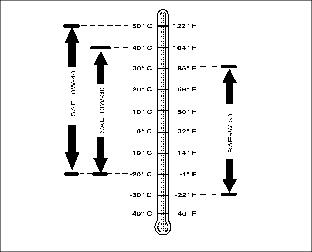
Use oil viscosity based on the expected air temperature range during the period between oil changes.
The following John Deere oils are preferred:
Other oils may be used if above John Deere oils are not available, provided they meet the following specification:
· API Service Classification SG or higher
Checking Engine Oil Level
1. Park tractor on a level surface. STOP engine. Let engine cool.
3. Clean area around dipstick to prevent debris from falling into crankcase.
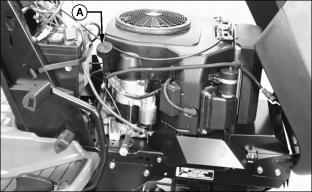
Picture Note: Model 2554HV used for photo purposes.
4. Remove dipstick (A). Wipe with clean cloth.
5. Insert dipstick into the tube and rest the oil fill cap on the tube. DO NOT thread the cap onto the tube.
6. Remove dipstick and check the oil level.
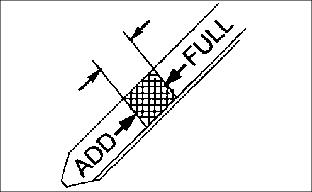
7. Oil must be between ADD and FULL marks.
8. Add oil to FULL mark if necessary. DO NOT overfill.
9. Install and tighten dipstick. Lower hood.
Changing Engine Oil
 c CAUTION: Avoid injury! Hot Engine and Hot Oil can cause severe burns. Allow engine temperature to drop from hot to warm level before attempting to change oil.
|
2. Park tractor on level surface. STOP engine, LOCK park brake and remove key.
3. Wipe debris and dirt from around dipstick.
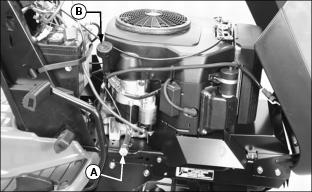
Picture Note: Model 2554HV used for photo purposes.
4. Put drain pan under drain extension (A).
5. Remove drain plug (A) and drain oil into oil drain pan.
6. Replace drain plug. Tighten to: 13.6 N·m (10 ft. lb.).
7. Remove dipstick (B) and refill with new oil of recommended grade.
· Approximate engine oil capacity: 2.1 L (2 qt.)
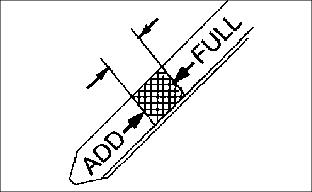
8. Install dipstick and then remove to check oil level. (See Checking Engine Oil in this section.) Oil level must be between ADD and FULL marks. Do not overfill.
9. Install and tighten dipstick.
10. Start engine and check for oil leaks. Correct any leaks before operating.
Changing Engine Oil Filter
1. Park tractor on level surface. STOP engine, LOCK park brake and remove key.
2. Drain engine oil and replace with fresh oil. (See Changing Engine Oil in this section.)
3. Wipe debris and dirt from around oil filter.
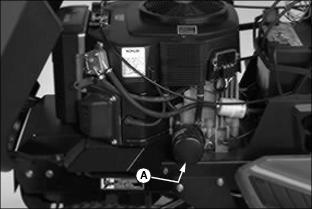
Picture Note: Model 2554HV shown for photo purposes.
4. Put a small shallow pan or funnel under oil filter (A) to catch oil drained from filter.
5. Remove old filter (A) and wipe off filter tray with a clean cloth.
6. Lightly oil filter gasket with fresh, clean oil.
7. Install replacement oil filter. Turn oil filter to the right (clockwise) until rubber gasket contacts filter adapter. Tighten filter an additional one-half turn.
8. Start and run engine at idle to check for leaks. Stop engine.
9. Check oil level. (See Checking Engine Oil Level in this section.)
10. Add oil if required. (See Engine Oil in this section.)
Cleaning Air Intake Screen and Engine Fins
1. STOP engine. LOCK park brake and remove key.
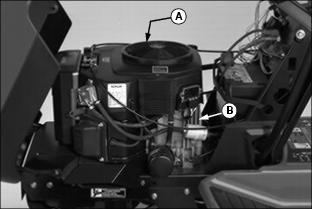
Picture Note: Model 2554HV shown for photo purposes.
3. Clean air intake screen (A), oil cooler fins (B) and external surfaces, with rag, brush, vacuum or compressed air. Lower hood.
Checking and Cleaning Air Cleaner Elements
NOTE: It may be necessary to check the air filter more frequently if operating vehicle in dusty conditions.
2. Clean any dirt and debris from the air cleaner area before removing cover.
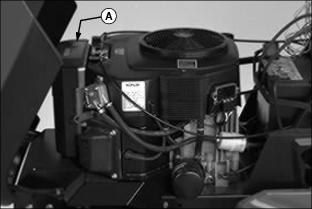
Picture Note: Model 2554HV shown for photo purposes.
4. Inspect foam precleaner (B) and element (C) without removing.
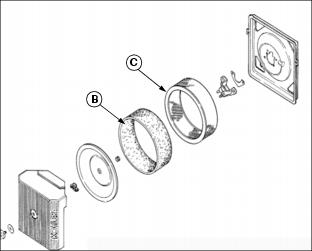
5. If precleaner (B) is dirty, carefully remove from filter, leaving element (C) in the air cleaner housing.
NOTE: DO NOT wash paper element.
6. Wash precleaner (B) in a solution of warm water and liquid detergent.
7. Rinse precleaner thoroughly. Squeeze out excess water in a dry cloth until precleaner is completely dry.
8. Put approximately 30 ml. (1 oz.) of clean engine oil onto precleaner. Squeeze precleaner to distribute oil evenly. Squeeze out excess oil with a clean cloth.
9. Remove and replace filter element (C) ONLY if damaged or very dirty.
10. Carefully remove element (C) from air cleaner housing. Replace with a NEW element.
11. Carefully clean air cleaner housing. Prevent any dirt from falling into carburetor.
12. Install precleaner onto new filter element and install into air cleaner housing.
13. Install cover. Lower hood.
Checking Spark Plugs
|
c CAUTION: Avoid injury! Before you remove spark plugs, STOP engine and wait until engine is cool.
|
1. Stop engine. Remove key. Lift hood.
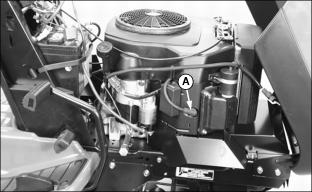
Picture Note: Model 2554HV used for photo purposes.
2. Disconnect spark plug wires (A), one on each side, and remove spark plugs.
3. Clean spark plugs carefully with a wire brush.
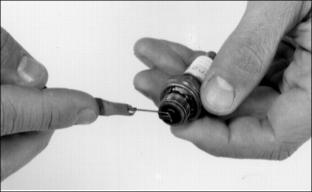
4. Check plug gap with a wire feeler gauge.
· Gap should be 0.76 mm (0.030 in.)
5. To change gap, move the outer electrode.
6. Install and tighten spark plug(s).
· Tighten plug(s) to: 24.4/29.8 N·m (18/22 lb.-ft.).
7. Connect the spark plug wires.
Replacing Fuel Filter
|
c CAUTION: Avoid injury! Keep cigarettes, sparks, and flames away from the fuel system. Make sure engine is cool to the touch.
|
IMPORTANT: Avoid damage! When disconnecting fuel tank hose from filter, be sure to hold hose above fuel tank level so fuel does not run out. |
NOTE: Change filter when fuel is low in fuel tank.
1. Park tractor on a level surface.
2. STOP engine. Remove key. Let engine COOL.
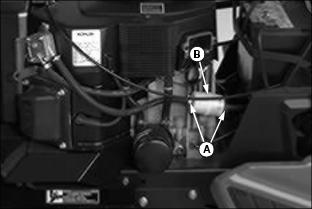
Picture Note: Model 2554HV shown for photo purposes.
4. Using pliers, slide hose clamps (A) away from fuel filter (B).
5. Disconnect hoses from filter.
6. Connect hoses to new filter.