
1200A Bunker and Field Vehicle
Introduction
Safety
Controls
Operating
Replacement Parts
Service Machine Safely
Service Intervals
Service Engine
Service Transmission
Service Steering & Brakes
Service Electrical
Checking Battery Electrolyte Level
Charging The Battery (Continued)
Replacing Headlights (Optional)
Service Miscellaneous
Troubleshooting
Assembly
Specifications
Warranty
John Deere Quality Statement

Service Electrical
Cleaning Or Replacing Battery
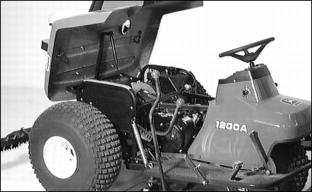
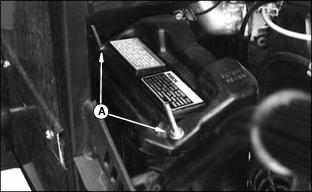
2. Loosen nuts (A) to remove hold-down clamp.
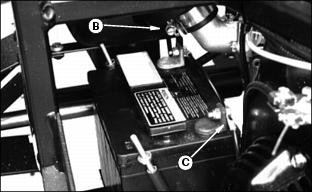
3. Remove negative (black) cable (B) from battery first.
4. Remove positive (red) cable (C).
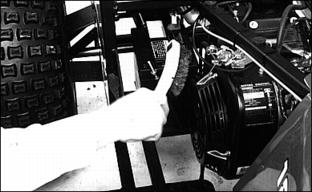
5. Clean battery with brush or cloth. Keep dirt out of battery cells.
6. Remove corrosion from battery terminals and cable ends with a wire brush.
7. If battery is very dirty, remove battery.
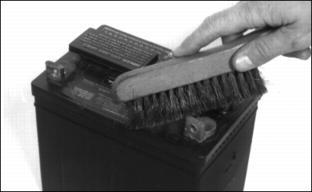
8. Clean battery, battery terminals, cable ends, hold-down cover, battery box, and other parts with a solution of 1 part baking soda to 4 parts water. KEEP solution out of battery cells.
9. Rinse all parts with clean water. Let dry.
11. Check cell cap to be sure vent holes are open.
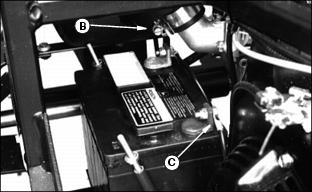
12. Connect positive (red) cable (C) to battery first, then negative (black) cable (B).
13. Apply petroleum jelly on battery terminals.
NOTE: Do not overtighten nuts. It may crack plastic.
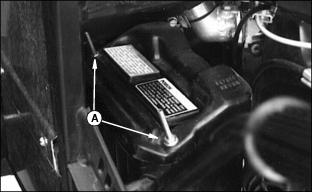
14. Install battery hold-down. Tighten nuts (A).
Checking Battery Electrolyte Level
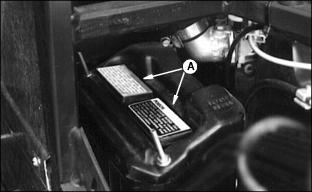
1. Remove battery manifold caps (A).
IMPORTANT: Avoid damage! DO NOT fill cells to the bottom of the filler neck (B). Electrolyte can overflow when a battery is charged and cause damage. |
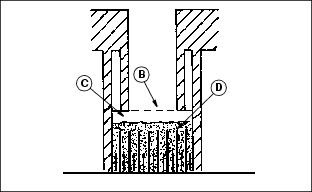
2. Electrolyte (C) should be 6 mm (1/4 in) above plates (D)..
3. Add distilled water if necessary.
Charging The Battery
Follow instructions on the battery charger or in the charger operator's manual, or use the instructions below as a guide.
Charging The Battery (Continued)
· Wait until the battery has warmed to room temperature. Do not charge a frozen battery.
· Check the electrolyte level of each cell. (See Checking Battery Electrolyte Level in this section.)
· Install the battery cap(s) on the battery.
Turn OFF and unplug the charger before you connect cables to the battery or disconnect cables from the battery.
If the battery becomes warm to touch during charging:
· Stop charging the battery until it cools.
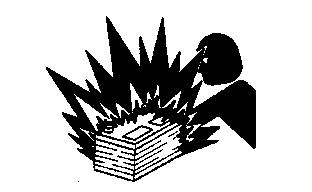
 c CAUTION: Avoid injury! DO NOT charge a frozen battery. Battery gases can explode. Keep cigarettes, sparks, and flames away from battery.
|
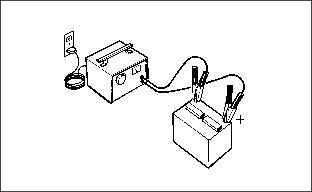
1. Remove and clean battery. (See Cleaning Or Replacing Battery in this section.)
2. Check electrolyte level. (See Checking Battery Electrolyte Level in this section.)
3. Leave cell caps on battery while you charge it.
|
c CAUTION: Avoid injury! To avoid injury, before you connect or disconnect charger cables to battery, unplug charger cord.
|
4. Connect positive (+) charger cable to positive (+) battery terminal.
5. Connect negative (-) charger cable to negative (-) battery terminal.
7. Charge battery. See CHARGING RATES on the next page.
8. Unplug charger cord. Remove charger cables.
Charging Rates
See your battery charger or charger operator's manual for information on charging. Or read the information below to FULLY CHARGE your battery.
For a charger with a CURRENT ADJUSTMENT CONTROL:
· Adjust the control to 10 amps.
· Charge the battery for 6-8 hours.
· Specific gravity should be 1.250
For a charger with a switch for MAINTENANCE FREE, DEEP CYCLE, or NORMAL (CONVENTIONAL) setting:
· Use the MAINTENANCE FREE or DEEP CYCLE setting.
Charging Rates (Continued)
For a charger with SLOW CHARGE, FAST CHARGE, or BOOST CHARGE setting:
· DO NOT use the BOOST CHARGE setting.
· Use the SLOW CHARGE setting:
· - For a charger rated at less than 10 amps.
· - Specific gravity should be 1.250.
· Use the FAST CHARGE setting:
· - For a charger rated at 10 amps.
· - Specific gravity should be 1.250.
NOTE: Your charger may have an AUTOMATIC STOP to prevent charging the battery:
· When the battery is fully charged OR
· When the battery is not in condition to take a charge.
Using Booster Battery
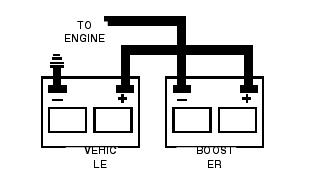
Connect positive (+) booster cable to booster battery positive (+) post (D).
Connect the other end of positive (+) booster cable to vehicle battery positive (+) post (A).
Connect negative (-) booster cable to booster battery negative (-) post (C).
Connect the other end of negative (-) booster cable to engine ground (B) away from battery.
Replacing Fuses
Two 20 Amp fuses (A) are used with two spares provided between the two active fuses.
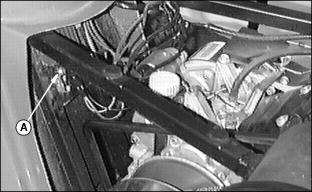
Testing Neutral Start System
|
c CAUTION: Avoid injury! Help prevent possible injury from operating unsafe machine. If machine does not pass test, DO NOT operate (See your John Deere Distributor.)
|
2. Engage the parking brake lock.
3. Move transmission shift pedals to forward or reverse position.
4. Turn key to the START position. Engine must not crank.
Replacing Headlights (Optional)
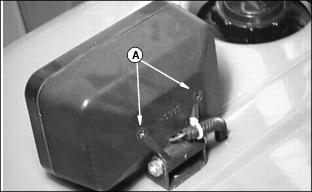
1. Turn Headlight switch to OFF position.
3. Pull lens assembly from housing.
4. Disconnect wires from bulb.
7. Install lens assembly in housing.
Checking Spark Plug
|
c CAUTION: Avoid injury! To help prevent bodily injury from burns, stop engine and allow to cool before removing spark plug.
|
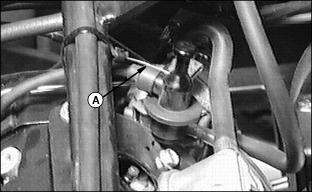
2. Disconnect spark plug wire (A).
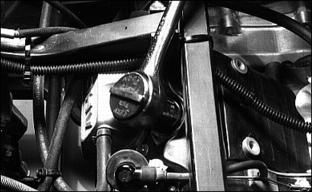
4. Clean plug carefully with a wire brush.
5. Inspect plug for cracked porcelain, pitted or damaged electrodes and other wear or damage.
NOTE: In Canada, replace with resister spark plugs only.
6. Replace spark plug if necessary.
7. Check plug gap with a wire feeler gauge.
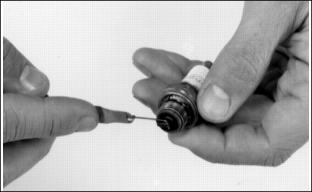
8. Gap must be between 64 mm (0.025-in).
9. To change gap, move the outer electrode.