Service Miscellaneous
Service Tires Safely
 c CAUTION: Avoid injury! Explosive separation of a tire and rim parts can cause serious injury or death:
· Do not attempt to mount a tire without the proper equipment and experience to perform the job.
· Always maintain the correct tire pressure. Do not inflate the tires above the recommended pressure. Never weld or heat a wheel and tire assembly. The heat can cause an increase in air pressure resulting in a tire explosion. Welding can structurally weaken or deform the wheel.
· When inflating tires, use a clip-on chuck and extension hose long enough to allow you to stand to one side and NOT in front of or over the tire assembly.
· Check tires for low pressure, cuts, bubbles, damaged rims or missing lug bolts and nuts.
|
Checking Tire Pressure
1. Check tires for damage
2. Check tire pressure with an accurate low pressure gauge.
3. Add air, if necessary.
Tire Size
|
Pressure - kPa (psi)
|
Front 22.5x10.9-8
|
27.6 - 41.4 (4-6 )
|
Rear 25x12-9
|
27.6 - 41.4 (4-6 )
|
Tightening Lug Nuts
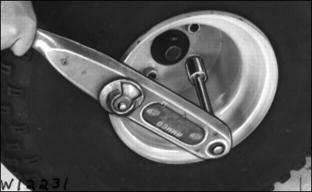
M77001
Tighten lug nuts to 80 N·m (60 ft.-lb):
· After first 10 hours of operation
· After first 20 hours of operation
· Every 200 hours there after.
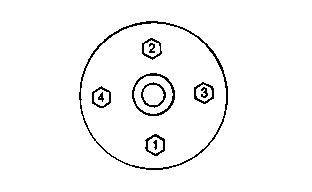
Install lug nuts. Beveled sides must face inward.
M77000
Tighten in sequence illustrated, alternately and evenly until recommended torque is reached.
Refueling Machine
|
c CAUTION: Avoid injury! Handle fuel with care, it is highly flammable:
· DO NOT refuel machine while you smoke, when machine is near an open flame or sparks, or when engine is running. STOP engine.
· Fill fuel tank outdoors.
· Prevent fires: clean oil, grease and dirt from machine. Clean up spilled fuel immediately.
· Do not store machine with fuel in tank in a building where fumes may reach an open flame or spark.
· To prevent fire and explosion caused by static electric discharge, while you fill tank, use a non-metal fuel container. If you use a funnel, MAKE SURE it is PLASTIC. Avoid using a funnel which has a metal screen or filter.
· Use only clean oil and fuel and clean approved containers and funnels.
· Store oil and fuel in an area protected from dust, moisture and other contamination.
|
IMPORTANT: Avoid damage! Avoid spilling fuel. Fuel can damage plastic and painted surfaces.
DO NOT mix oil with gasoline. Unleaded gasoline with an octane rating of 87 or higher is recommended.
Fuel tank capacity: 13.25 L (3.5 gal).
|
· Use only clean, fresh, unleaded regular grade gasoline.
· Remove any trash from top of fuel tank drain area.
· Never use fuel that is stale or has been stored for a long period of time:
Warm Weather: Maximum 60 days.
Cold Weather: Maximum of 90 days.
· Fill fuel tank at the end of each day's operation. This helps to keep condensation out of fuel tank.
Oxygenates (either ethanol or MTBE) are added to the gasoline. If you use the oxygenated fuel be sure it is unleaded and meets the minimum octane rating requirement.
The following are the EPA approved percentages of fuel oxygenates:
ETHANOL (Ethyl or Grain Alcohol): You may use gasoline containing up to 10 percent ethanol by volume.
MTBE (Methyl Tertiary Butyl Ether: You may use gasoline containing up to 15 percent MTBE by volume.
METHANOL (Methyl or Wood Alcohol): You may use gaoline containing up to 5 percent methanol by volume, as long as it also contains cosolvents and corrosion inhibitors to protect the fuel system. Gasoline containing more than 5 percent methanol by volume may cause starting and/or performance problems. It may also damage metal, rubber, and plastic parts of your fuel system.
Filling Fuel Tank (Continued)
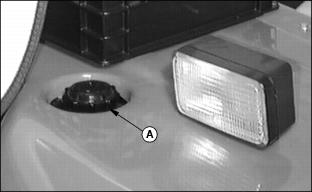
M77049
1. STOP engine. If engine is hot let it cool several minutes before you add fuel.
2. Remove any trash from area around fuel tank.
3. Remove fuel tank cap (A).
4. Fill tank only to bottom of filler neck.
5. Install fuel tank cap.
Storing And Handling Fuel
Buy clean, high quality fuel.
IMPORTANT: Avoid damage! Keep dirt, scale, water or other foreign debris out of fuel.
|
Keep fuel in clean container in a protected area away from buildings.
Keep storage tank on its side with plug wire up.
Drain water and sediment from storage tank regularly.
Avoid storing fuel for a long time. If you keep fuel for a long time, add a fuel conditioner to prevent water condensation and varnish. (See your John Deere Distributor for conditioner.)
|